
DRRC Conversations - Youth Re (defining Resilience): Building together for now and the future
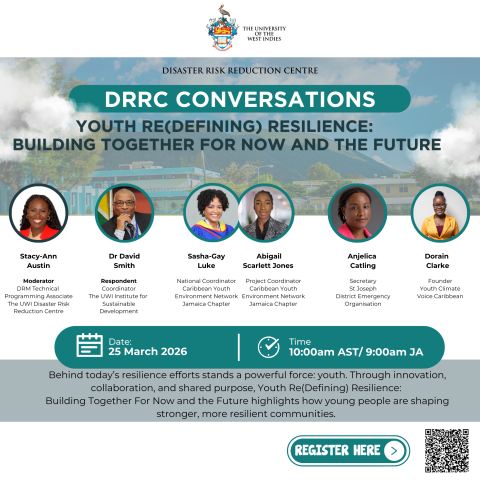
Behind today’s resilience efforts stands a powerful force: youth. Through innovation, collaboration, and shared purpose, Youth Re(Defining) Resilience: Building Together For Now and the Future "DRRC Conversations" highlighted how young people are shaping stronger, more resilient communities.
Hazard impacts are increasing in magnitude and frequency due to the changing climate coupled with our actions as well as inaction. These impacts are especially acute and life-threatening for youth and other vulnerable groups. The Regional CDM Strategy, Sendai Framework for Disaster Risk Reduction and Sustainable Development Goals call on governments and other decision-makers to include children and youth in the design and implementation of policies, plans and standards. Achieving this inclusivity requires the youth’s meaningful participation in the decision-making process.
Globally, youth are feeling empowered and are responding and leading discussions on disaster preparedness and resilience planning to mitigate the impact of natural hazards in their countries. In the Caribbean, youth voices are also being engaged to bolster regional approaches to address its vulnerability.
Findings from a Regional Youth Survey on Comprehensive Disaster Management and Climate Resilience undertaken in 2024 by The UWI DRRC and Caribbean Youth Environment Network with the support through USAID under the Eastern and Southern Caribbean Policy and Regulatory Reform for Resilience Activity, revealed that the youth in the Caribbean perceive disaster resilience as “being safer”, “quick recovery”, “adapting” and “being prepared” and felt that the majority of the public awareness activities focused heavily on climatic hazards.
Results further revealed that the youth believes that the primary causes that contribute to the severity of disasters are “lack of understanding of hazards” as well as “ineffectiveness of the country’s disaster management institutions, laws and other governance arrangements”.
The findings reaffirmed that Caribbean youth, as the region’s emerging leaders, must be taken seriously and engaged more deliberately in building long-term resilience. Many of the youth respondents indicated limited awareness of available resources, such as training and financing, designed to support community resilience efforts. This underscores the need to enhance youth involvement in DRM and CR initiatives and highlights the value of establishing youth resilience funds supported by governments, development partners, academia and the private sector.
As the DRRC approaches its 20th anniversary in June 2026, the Centre seeks to highlight its legacy of regional impact while investing in the next generation of resilience leaders. Empowering youth is critical to building long-term community resilience. March 2026 edition of DRRC Conversations provided a space for The UWI alumni and young professionals to share how they are (redefining) resilience through innovation and people-centered community action. This edition was moderated by Stacy-Ann Austin, DRM Technical Programming Associate with The UWI Disaster Risk Reduction Centre (DRRC), who supports the design, coordination and implementation of regional DRM initiatives, across Caribbean Small Island Developing States (SIDS), supporting national CDM work programmes, performance frameworks, and stakeholder capacity building.
The Respondent was Dr. David C. Smith, Coordinator of the Institute for Sustainable Development at The University of the West Indies and Caribbean Coordinator for the United Nations Sustainable Development Solutions Network. An ecologist with nearly 30 years’ experience, his work spans sustainable development, biodiversity, climate change, and disaster risk reduction across academia, civil society, the private sector, and the UN.
Speakers included
- Sasha-Gay Luke, a National Coordinator at Caribbean Environment Network, and a Jamaican youth from a marginalised community that is affected by environmental degradation and stigmatisation. With the understanding that science can change the world and supported by Gandhi's "be the change you wish to see the world", she is willing and ready to create and use every opportunity to use science to advocate for the Jamaican youth and marginalised groups to bridge gaps to equality and equitability.
- Abigail Scarlett Jones serves as Project Coordinator for the Caribbean Youth Environment Network (Jamaica), where she advances regional efforts in climate adaptation, community resilience, and sustainable resource management. Deeply committed to women’s empowerment, Abigail also actively advocates for the inclusion, leadership, and holistic advancement of women across all spheres of life.
- Anjelica Catling’s personal and professional life both focus on improving the resilience of Barbados against potential disasters. Professionally, she is a Project Engineer with the Climate Resilient and Sustainable Integrated Coastal Zone Management Program at the Coastal Zone Management Unit (CZMU), where she contributes to projects focused on coastal resilience. Personally, she serves as the Secretary of the St. Joseph District Emergency Organisation (DEO), a voluntary arm of the Department of Emergency Management (DEM) in Barbados. In this role, she is dedicated to ensuring community readiness against disasters which includes local emergency planning, coordination with local groups, and effective mobilization of resources to support the St. Joseph community.
- Dorain Clarke is the Founder and Lead of Youth Climate Voice Caribbean (YCVC), a youth-led initiative dedicated to promoting climate literacy, disaster preparedness, and youth engagement in climate action across the Caribbean. She is passionate about improving climate communication and early warning awareness to ensure that vulnerable communities are better prepared for climate-related hazards. Her work focuses on strengthening climate literacy, disaster preparedness, and youth engagement in climate resilience across the Caribbean.
The speakers shared information on the projects they designed and implemented through the DRRC Disaster Risk Management and Resilience Microgrants for Youth and Community Groups programme.


