CAMPUS AND CENTRE REPORTS
Board for Undergraduate Studies
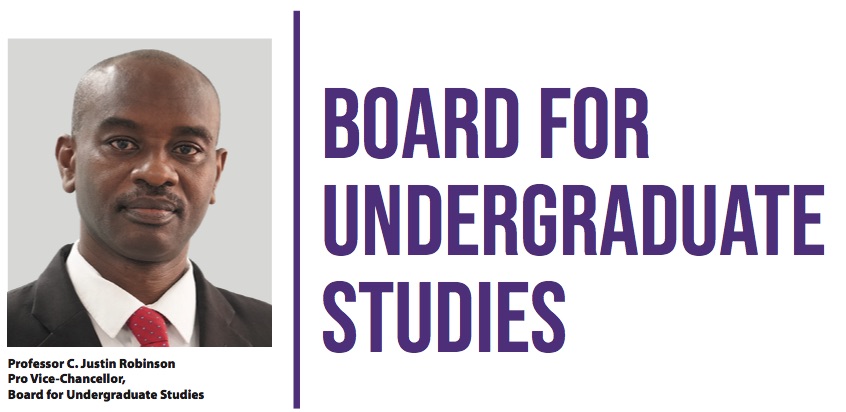
The Office of the Board for Undergraduate Studies (OBUS) supports the University’s mission through its focus on policy, quality assurance, and regional engagement. OBUS advances the mandate of the Board for Undergraduate Studies (BUS) by developing frameworks and strategies to enhance undergraduate education, aligning with the University’s broader strategic pillars.
Strategic Framework and Vision
The BUS approved the OBUS’s Strategic Framework, “Reimagining Undergraduate Education: Up the Shine,” designed to foster innovation, collaboration, and excellence across campuses. This framework guides internal operations and relationships with external stakeholders, ensuring that undergraduate education remains relevant and future-oriented.
ACCESS AND REGIONALITY
OBUS is committed to widening access to education through flexible learning pathways, technological integration, and improved cross-campus collaboration. It has enhanced the transferability of undergraduate certification and streamlined regional application and registration processes, while adapting offerings to future-proof undergraduate programmes
Scholarships and Student Support
OBUS manages key scholarships, including the Open Scholarship and the UWI/CXC CSEC scholarship. For the 2024/2025 academic year, six new scholars were awarded, totalling US$146,154 in investment. There are 20 continuing scholars. These scholarships broaden educational access and foster regional integration.
Programme Approvals and Partnerships
During the reporting period, BUS approved 15 new or revised bachelor’s degrees and minors, one undergraduate diploma, and two undergraduate certificates across various campuses. Notable franchise
arrangements include:- Renewal of the BSc Nursing programme at St. Vincent and the Grenadines Community College and Clarence Fitzroy Bryant College.
- A 2+2 agreement between UWI Five Islands’ School of Business and Management and Dominica State College.
- A new MOU between the Global Campus and Pre-Poly Tech for Associate Degrees in Business Management, Paralegal Studies, and Social Work.
Expanding Pathways and the One UWI Culture
OBUS completed an evaluation of the Multi- Campus Teaching and Learning Initiative. While initial challenges were noted, the initiative has proven feasible for promoting a unified University culture. Efforts are underway to scale and harmonise processes across all campuses.
ALIGNMENT
Strategic, Policy, and Structural Initiatives OBUS operationalised the University’s Alignment pillar, focusing on structural, financial, and innovation perspectives. Key achievements include:
Policy Alignment
OBUS led the creation and review of policies governing undergraduate education, emphasising the importance of remaining at the cutting edge while upholding academic integrity. In 2024, policy work centred on artificial intelligence and academic integrity led to the approval of the “AI Squared” policy suite by BUS and the Board for Graduate Studies and Research. Ongoing consultations have refined these policies to address the evolving academic landscape.
English Language Proficiency
To ensure alignment across campuses, BUS approved a cap on English Language Proficiency Test (ELPT) attempts and mandated registration for remedial courses for unsuccessful candidates. The course code was also harmonised university-wide.
STRUCTURAL ALIGNMENT AND QUALITY ASSURANCE
BUS redefined the status of the Quality Assurance Unit (QAU), integrating it more closely with OBUS. The QAU conducted 21 quality evaluations (including franchise and articulation arrangements) and 16 quality assurance reviews, out of 25 and 19 planned, respectively. Unconducted reviews were due primarily to scheduling conflicts.
Professional Development and Publications
OBUS staff engaged in approximately 40 professional development activities, including conferences and workshops on digital pedagogy, AI in higher education, academic integrity, and gender equality in teaching. OBUS’s publications— Quality Education Forum and The UWI Quality Circle Newsletter—featured topics such as sustainability in higher education and data protection. Staff also contributed to 14 journal articles, 10 book chapters, and 3 books (1 solo-authored, 2 edited).
AGILITY
Responding to Change
OBUS enhanced its internal operations to respond more quickly to changing external and internal demands, leveraging digital tools to improve efficiency. A concept paper outlined procedures for adjusting programmes, and an ad hoc sub-committee was established to further develop these processes.
Student Success, Leadership, and Capacity Building
Students remain central to OBUS’s mission. Initiatives such as the “Conversation with the PVC” series and planning for the inaugural biennial undergraduate students’ conference underscore this focus. The conference theme, “Our World in 2050: Reimagining Roles, Rights, Responsibilities, and Relationships,” reflects OBUS’s forward-looking vision.
Strategic Pivoting Amid Global Shifts
Recognising global shifts, OBUS authored a strategic white paper on positioning The UWI as a competitive destination for international students, particularly from the global south. This initiative responds to changing visa policies and the rise of generative artificial intelligence, aiming to attract new learners and meet evolving expectations.
Service to the University
OBUS staff contribute widely across the University, serving on standing and ad hoc committees related to academic quality assurance, curriculum review, and institutional accreditation. Additionally, they facilitate courses, act as examiners, and supervise doctoral students, demonstrating commitment to institutional service and academic excellence.
Conclusion
The 2024/2025 reporting period highlighted OBUS’s pivotal role in driving undergraduate policy, quality assurance, and regional integration at The UWI. Through strategic alignment, agile operations, and a strong emphasis on student success, OBUS continued to advance the University’s mission and respond proactively to the challenges and opportunities of higher education in a rapidly changing world.

