Enrolment and Financial Performance
Total enrolment surged by 77%, reaching
1,403 students, and Semester One enrolment
surpassed 1,000 for the first time. Tuition
revenue climbed 65% to EC$7.08 million, with
total revenue at EC$29.31 million, reflecting a
robust financial trajectory. This increase was
driven by technology-driven improvements
to the applicant pipeline, including
automated admissions, enhanced reporting,
and coordinated applicant engagement.
These measures improved conversion rates
and the overall student experience.

EXPANSION OF ACCESS
AND STUDENT SUCCESS
The Campus expanded access across
undergraduate, postgraduate, and short-
course offerings, emphasising education as
a tool for transformation. Awards to learners
increased from 132 in 2022 to 341 in 2024.
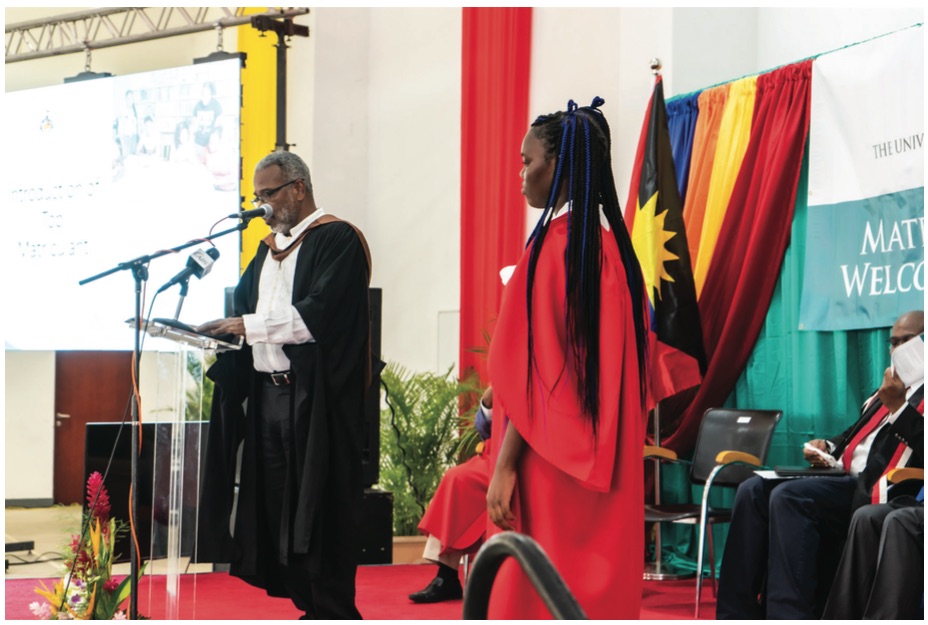
Purposeful community engagement led to
a participant from the prison community
delivering the valedictory address,
exemplifying the impact of UWI’s Seeds of
Hope Programme, which fosters rehabilitation
through education.
Facility upgrades included
a new student computer lab, a multi-science
laboratory, informal learning spaces, and
improved amenities, all contributing to
a more inclusive and supportive student
environment. The Campus also broadened its
regional reach, attracting students from across
the OECS and deepening engagement with
secondary schools.
INDUSTRY ALIGNMENT
AND EXTERNAL ENGAGEMENT
FIC strengthened industry alignment and
employability through initiatives such as the annual Career
Expo, which brought together employers, students, and
secondary school participants. The Campus hosted the Pan
American Health Organisation’s HEARTS Initiative, a first for
university campuses globally, highlighting FIC’s growing
stature in health leadership. Academic and public
engagement advanced through high-profile events,
including a public lecture by Professor Mario Sousa,
the second annual Caribbean Artificial Intelligence
Conference, and the 26th Annual SALISES Conference,
enhancing FIC’s reputation as a hub for research and
policy dialogue.
Community and Philanthropy
Community partnerships flourished, notably through
the adoption of Five Islands Primary School and successful
fundraising events. The Campus fostered inclusivity
and national pride by hosting the Independence
Village and Food Fair. Student support was bolstered
by philanthropic initiatives, including the donation of
20 laptops, and health outreach was maintained via
recurring wellness campaigns.
Academic Programme Development and Quality
The academic portfolio evolved to address regional
workforce needs, with preparatory work underway for new
programmes in health sciences, food and agriculture, and
legal studies. Institutional quality was affirmed through
renewal of registration by the Antigua and Barbuda
National Accreditation Board. FIC Insights, a feedback
system, was launched to enhance responsiveness and
continuous improvement in service delivery.
Research and Scholarly Engagement
Research capacity expanded, anchored by the Centre
of Excellence for Oceanography and Blue Economy. The
BEACON Project’s selection as a finalist in a UN Global Call
and a US$250,000 partnership with the International Seabed
Authority marked major advances for marine science and
climate resilience research. Faculty contributed significantly
to regional and international scholarship, reinforcing FIC’s
growing research profile.
Staffing and Institutional Capacity
The Campus expanded its human resource base with
new academic and professional appointments, enhanced
performance management, and ongoing staff development.
These efforts supported the needs of a growing student
population and underpinned institutional effectiveness.
OPERATIONAL AGILITY
AND MODERNISATION
The modernisation agenda advanced rapidly with the deployment
of Banner SaaS, including Student and Finance modules, achieving record
implementation timelines. Academic technology support, classroom
readiness, and service desk operations were enhanced to ensure a stable
digital learning environment. Communication and coordination with UWI
stakeholders improved and strengthened operational responsiveness.
Financial Sustainability
Financial sustainability improved alongside operational growth.
Revenue increased by 19%, staff costs as a proportion of revenue declined,
and total assets reached EC$35.14 million. The accumulated surplus rose
to EC$29.55 million, providing a solid base for future investment and
programme growth.
Innovation and Entrepreneurial Initiatives
FIC advanced innovation and entrepreneurship through platforms
such as the Caribbean AI Conference and community webinars, fostering
applied learning, skills development, and industry partnerships. The Campus
prioritised innovation in student recruitment through initiatives such as
Walk-In Wednesday clinics, which provide real-time support to prospective
students. Plans for dedicated innovation and practical learning spaces
were embedded in expansion blueprints, supporting future enterprise and
creativity.
Conclusion
The year closed with the Five Islands Campus firmly positioned for
continued growth and leadership within the UWI system and the wider
Caribbean. Achievements in enrolment, revenue generation, academic
development, research, community engagement, and operational
modernisation underscore FIC’s role as a responsive, accessible, and self-
sustaining institution. The Campus is on a trajectory to deepen its regional
impact as it enters its next phase of development.