
Future-Proofing: One Step Backward, Two Steps Forward
UWI-GLASGOW PARTNERSHIP
History was made in December 2024 as five trailblazing scholars became the world’s first graduates of the Master’s in Reparatory Justice—a pioneering double-degree programme by The UWI and the University of Glasgow. Developed through the Glasgow- Caribbean Centre for Development Research, the programme immerses students in the legacies of slavery and colonialism, and in the urgent pursuit of global justice. Graduates study across campuses in Jamaica, Barbados, and Scotland, gaining unique perspectives while working alongside leading experts in reparations research.
Graduates like Fer Ortiz Vivas and Fanny Olsson described the experience as transformative, opening doors to global scholarship and activism. Their research spanned historic compensation schemes, gender, health, and the ongoing intersections of justice and healing. The UWI Vice-Chancellor, Sir Hilary Beckles, and Glasgow’s Sir Anton Muscatelli, hailed the inaugural cohort as torchbearers for a new era in reparative justice. The ceremony was marked by powerful symbols—a Ghanaian Kente stole representing unity and the Sankofa bird, urging us to learn from the past. The milestone signalled a bold step toward a more just and equitable future, inspiring a new generation of global leaders.
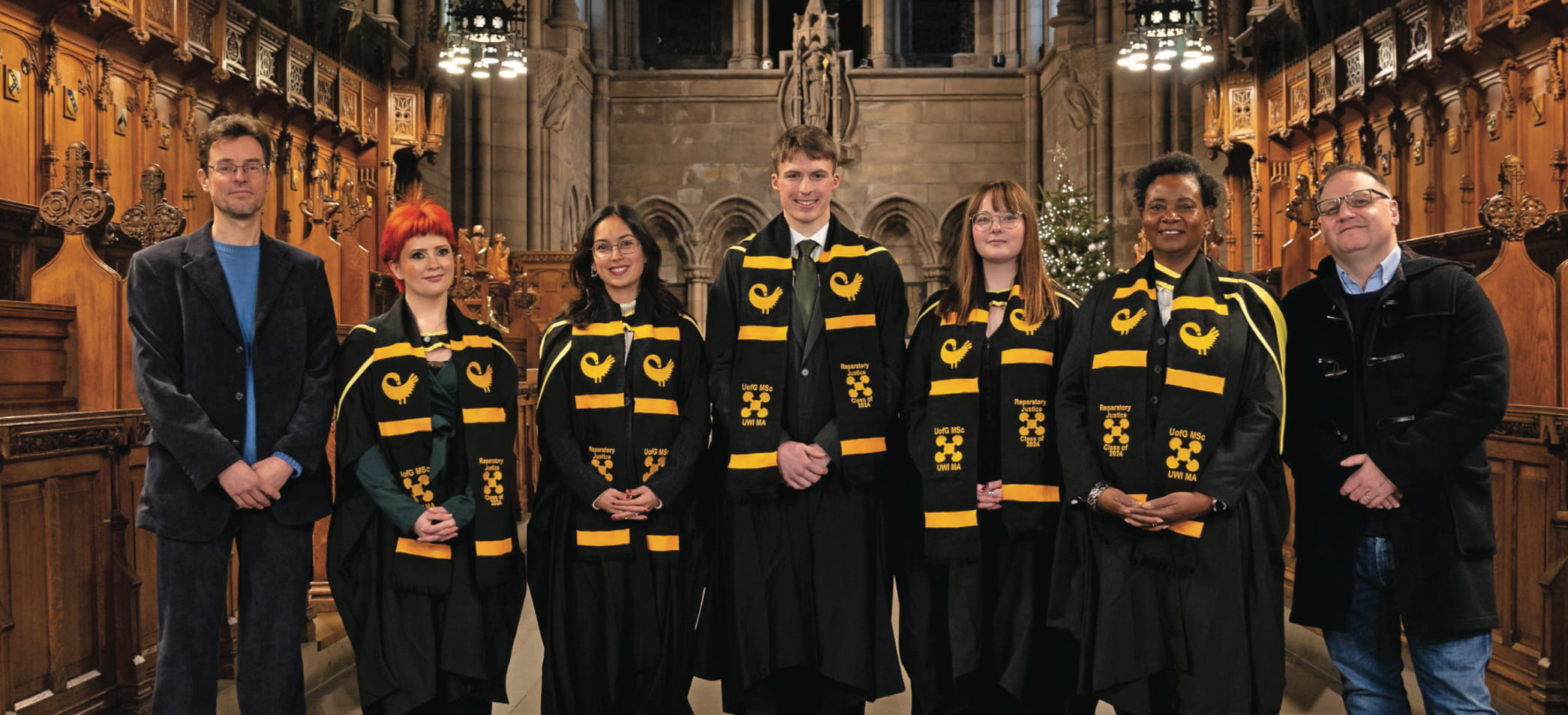 First students graduate from pioneering Reparatory
Justice Masters Programme. A historic milestone has
been reached as the first cohort of students graduates
from the world’s first Masters in Reparatory Justice.
Pictured in the University of Glasgow Chapel
Left to right: Dr Jelmer Vos, Senior Lecturer in History;
Reparatory Justice Masters graduates Nicole Whyte;
Fer Ortiz Vivas, Fergal O’Donohoe; Fanny Olsson,
Cordelia Asamoah and Dr Stephen Mullen, Lecturer
in History.The graduation stoles worn by the scholars
were a gift from Reparatory Justice Masters graduate
Cordelia Asamoah to her fellow graduates.They are
Kente stoles made in Ghana. The Sankofa bird is the
embodiment of the Akan word meaning “go back and
get it” representing the theme of “looking to the past
to inform the future”. The geometric symbol is Akoma
Ntoso “linked hearts” metaphorically representing
unity and agreement or harmony within communities.
First students graduate from pioneering Reparatory
Justice Masters Programme. A historic milestone has
been reached as the first cohort of students graduates
from the world’s first Masters in Reparatory Justice.
Pictured in the University of Glasgow Chapel
Left to right: Dr Jelmer Vos, Senior Lecturer in History;
Reparatory Justice Masters graduates Nicole Whyte;
Fer Ortiz Vivas, Fergal O’Donohoe; Fanny Olsson,
Cordelia Asamoah and Dr Stephen Mullen, Lecturer
in History.The graduation stoles worn by the scholars
were a gift from Reparatory Justice Masters graduate
Cordelia Asamoah to her fellow graduates.They are
Kente stoles made in Ghana. The Sankofa bird is the
embodiment of the Akan word meaning “go back and
get it” representing the theme of “looking to the past
to inform the future”. The geometric symbol is Akoma
Ntoso “linked hearts” metaphorically representing
unity and agreement or harmony within communities.

